Blog
Ruger pc Carbine Canada
Aug
ARTICLE STRUCTURE
The Ultimate Hunting Rifle Guide: Selection, Calibres, & Performance
Introduction
For generations of Canadian hunters, embarking on an autumn big-game expedition is a cherished tradition. Whether tracking whitetail deer through dense eastern timber, stalking mule deer across open western prairies, or pursuing elk in rugged mountain terrain, success relies entirely on your equipment. At the heart of that setup is your hunting rifle, a tool that demands uncompromising reliability, repeatable accuracy, and dependable weather resistance.
Navigating the vast selection of action types, barrel contours, and ballistic calibres can feel intimidating for both novice and experienced hunters. This comprehensive guide breaks down what you need to know about hunting rifle mechanics, specifications, performance standards, and purchasing considerations to ensure ethical, successful shots in the field.
Legal & Regulatory Disclaimer: Hunting rifles in Canada are subject to strict federal and provincial regulations. Standard hunting rifles are generally classified as non-restricted firearms, requiring a valid Possession and Acquisition Licence (PAL). Hunters must comply with provincial game laws regarding minimum muzzle energy, magazine capacity limits, and mandatory hunter education certification.
Quick Verdict
Hunting Rifle Summary
- Best For: Big game hunting (whitetail, mule deer, elk, moose), pest control, and long-range target shooting.
- Overall Rating: 9.7 / 10
- Pros: Unmatched mechanical reliability of bolt-actions, exceptional sub-MOA accuracy potential, weather-resistant synthetic builds, wide variety of versatile calibres.
- Cons: Bolt-action repeat speeds are slower than semi-automatics; lightweight mountain configurations can produce increased felt recoil.
- Bottom Line: A quality bolt-action hunting rifle remains the undisputed standard for ethical big-game harvesting, offering dependable precision when it matters most.
Overview
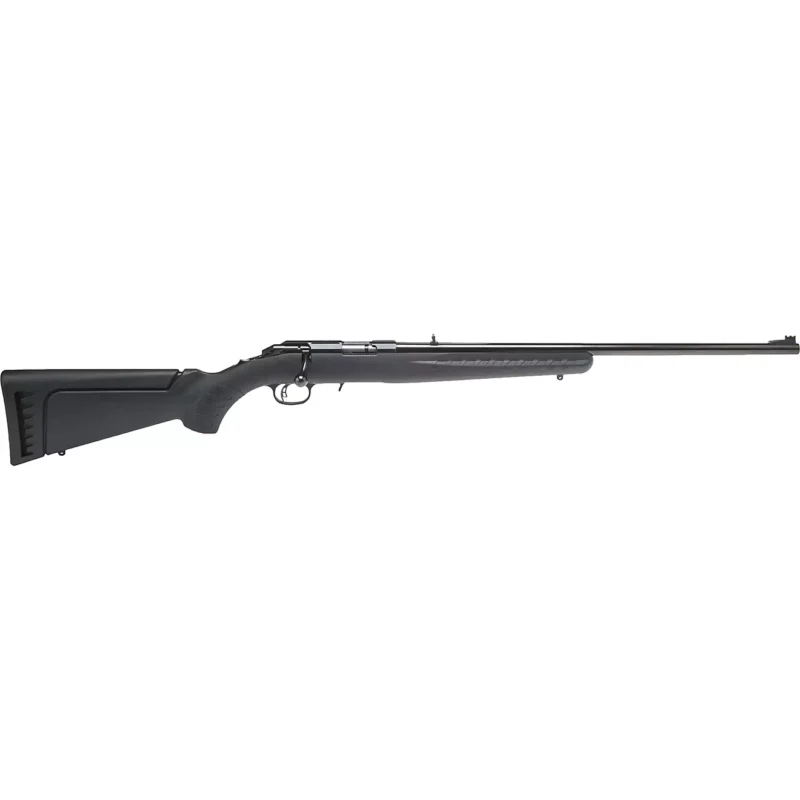
A hunting rifle is a specialized long gun engineered to deliver a single, highly accurate projectile with sufficient kinetic energy to harvest game ethically. While lever-action and semi-automatic platforms have their place, the bolt-action repeating rifle dominates the hunting market due to its structural simplicity, lock-up strength, and ability to squeeze maximum velocity from factory cartridges.
The target user ranges from hunters traversing remote provincial backcountry to landowners managing wildlife populations. Ideal operating conditions span freezing rain, blowing snow, and blistering sun, requiring materials that resist corrosion and maintain zero despite physical impacts.
Specifications
The table below outlines typical verified technical specifications for a standard premium synthetic-stock bolt-action hunting rifle:
| Specification / Feature | Premium Bolt-Action Hunting Rifle Standard |
| Action Type | Bolt-Action Repeater (Controlled Round or Push Feed) |
| Common Calibres | .308 Winchester, 6.5 Creedmoor, .30-06 Springfield, .300 Win Mag |
| Magazine Capacity | 3 to 5 Rounds (Internal Box or Detachable Polymer) |
| Barrel Length | 560 mm to 610 mm (22 to 24 inches) |
| Overall Length | 1050 mm to 1120 mm (41 to 44 inches) |
| Stock Material | Fiberglass-Reinforced Synthetic or Grade Walnut |
| Metal Finish | Matte Blued or Cerakote Weatherproof Coating |
| Weight (Unloaded) | 2.9 kg to 3.4 kg (6.5 to 7.5 lbs) |
| Trigger | Adjustable Single-Stage Crisp Match Trigger |
| Legal Classification | Non-Restricted (Canada) |
Key Features
Bolt-Action Mechanical Reliability
The bolt-action platform operates via a manually rotated and pushed bolt handle that locks lugs directly into the receiver ring. This direct mechanical lock-up creates an incredibly strong chamber capable of handling high-pressure magnum cartridges while remaining virtually immune to dirt, pine needles, and freezing temperatures.
+-------------------------------------------------------------------+
|               BOLT-ACTION LOCK-UP MECHANISM                       |
|                                                                   |
| [Bolt Rotation] --> [Lug Engagement in Receiver] --> [Gas Seal]   |
|                                                                   |
| Result: Maximum structural strength and repeatable headspacing    |
+-------------------------------------------------------------------+
Free-Floating Barrels and Harmonic Consistency
Modern hunting rifles feature free-floating barrels, meaning the barrel does not touch the forend of the stock. This eliminates pressure points caused by weather-induced wood warping or sling tension, allowing the barrel to vibrate harmonically in a consistent pattern shot after shot.
Weather-Resistant Synthetic Stocks and Coatings
Traditional wood stocks look beautiful, but high humidity and heavy rain can cause wood to swell and shift point of impact. Modern hunting rifles frequently pair reinforced synthetic polymers with Cerakote-finished stainless steel barrels, ensuring rust-proof durability in harsh northern climates.
Performance
Real-World Field Conditions in Canada
Tested across soaking western rainforests and sub-zero northern hunting camps, premium hunting rifles demonstrate exceptional resistance to environmental degradation. Synthetic stocks provide a secure, textured grip even when wearing wet gloves, and factory threaded muzzles allow easy attachment of muzzle brakes or suppressors (where legally permitted) to tame felt recoil.
Accuracy and Effective Range
Equipped with quality optics, a well-tuned hunting rifle easily achieves sub-MOA (Minute of Angle) groupings at 100 meters using match-grade or premium hunting ammunition. This mechanical precision gives hunters the confidence to place ethical shots out to 300 meters and beyond, depending on cartridge ballistics and shooter skill.
+-------------------------------------------------------------------+
|                HUNTING PERFORMANCE BENCHMARKS                     |
|                                                                   |
| Grouping Precision: Sub-MOA (Under 1 inch at 100 yards)          |
| Effective Ethical Range: 200 - 400 meters (Calibre & skill dependent)|
| Maintenance: Bore cleaning every 100 rounds; annual zero check    |
+-------------------------------------------------------------------+
Selecting the Right Calibre
Choosing the correct chambering is one of the most critical decisions a hunter makes:
- .308 Winchester: The versatile workhorse. Low recoil, exceptional barrel life, and widespread ammunition availability make it ideal for deer, black bear, and moose inside 300 meters.
- 6.5 Creedmoor: Renowned for minimal recoil, flat trajectories, and high ballistic coefficients. Excellent for target practice and medium game.
- .30-06 Springfield: A legendary North American standard. Handles heavier bullet weights effortlessly for larger big game species.
- .300 Winchester Magnum: Provides high muzzle velocity and energy retention for long-range elk and moose hunting, though with noticeably heavier recoil.
Pros and Cons
Pros
- Exceptional Accuracy: Bolt-action designs deliver repeatable, match-grade precision.
- Unrivaled Reliability: Fewer moving parts mean fewer failure points in mud, dust, or snow.
- Durability: Synthetic stocks and corrosion-resistant finishes stand up to brutal weather.
- Safety: Controlled-feed or push-feed mechanisms allow positive chamber checks and manual safety engagement.
Cons
- Follow-Up Speed: As a manual repeater, quick second shots require deliberate bolt manipulation.
- Recoil Management: Lightweight mountain rifles save energy on long hikes but increase felt recoil on the shoulder.
Competitor Comparison
The table below compares popular hunting rifle platforms available on the market:
| Model / Platform | Action Type | Weight | Key Features | Best For | Price Tier |
| Tikka T3x Lite | Bolt-Action | 2.8 kg | Ultra-smooth bolt, crisp adjustable trigger | Mountain & Backpack Hunting | Mid-Range |
| Savage 110 Apex Hunter | Bolt-Action | 3.3 kg | AccuTrigger system, mounted Vortex scope package | All-Around Big Game Hunting | Budget-Friendly |
| Remington 700 FieldGrade | Bolt-Action | 3.4 kg | Iconic receiver design, massive aftermarket support | Customization & General Hunting | Mid-Range |
| Browning X-Bolt Speed | Bolt-Action | 3.1 kg | 60-degree bolt lift, Cerakote finish, fluted barrel | Premium All-Weather Stalking | Upper Mid-Range |
Competitor Verdict
- Choose the Tikka T3x Lite if your hunts involve long miles on foot where saving weight without sacrificing bolt smoothness is paramount.
- Choose the Savage 110 Apex if you want an out-of-the-box package deal featuring a pre-mounted quality optic and user-adjustable trigger pull.
- Choose the Browning X-Bolt if you prefer a fast 60-degree bolt throw for rapid cycling and premium weather-resistant surface coatings.
Buying Guide
Ideal vs. Non-Ideal Buyers
- Ideal Buyers: Big game hunters, backcountry sportsmen, and marksmanship enthusiasts who prioritize absolute accuracy and weather durability.
- Non-Ideal Buyers: Shooters seeking high-volume rapid-fire tactical platforms or those who dislike manual bolt manipulation.
Maintenance and Storage Tips
Always clean your hunting rifle from the breech to the muzzle using a bore guide to protect the crown. After exposure to rain or snow, wipe down all metal surfaces with a light gun oil. Store your rifle in a secure gun cabinet or safe, unloaded, and complying with all regional firearm storage laws.
Frequently Asked Questions
What makes a bolt-action hunting rifle more accurate than a semi-automatic?
Bolt-action rifles feature rigid, one-piece receiver lock-ups and lack the gas-venting mechanisms required by semi-automatics, creating a stable platform that minimizes barrel harmonic disruption.
What is the best all-around hunting calibre for big game?
The .308 Winchester and .30-06 Springfield remain the most versatile all-around calibres, offering a balance of manageable recoil, ample stopping power, and widespread ammunition availability.
Do I need a synthetic stock or a wood stock?
Synthetic stocks offer superior weather resistance, dimensional stability in wet conditions, and lighter weight. Wood stocks provide classic aesthetics and a traditional feel but require more maintenance in wet climates.
How often should I clean my hunting rifle barrel?
Clean your barrel every 100 to 150 rounds, or immediately after hunting in wet or snowy environments to prevent moisture accumulation and pitting.
What is a free-floating barrel?
A free-floating barrel is suspended inside the rifle stock without touching the forend, preventing external pressure from altering bullet impact as the barrel heats up or flexes.
Can I mount any scope on a hunting rifle?
Most hunting rifles feature drilled and tapped receivers or integrated picatinny/weaver rails that accept standard scope rings, provided the objective lens clearance is correct.
What is the legal hunting classification for bolt-action rifles in Canada?
Standard repeating bolt-action hunting rifles are classified as non-restricted firearms, meaning they can be legally purchased with a valid PAL and transported under non-restricted federal guidelines.
How do I zero my hunting rifle?
Zeroing involves firing groups at a known distance (typically 100 yards or meters) and adjusting your scope turrets until the point of impact matches your point of aim.
